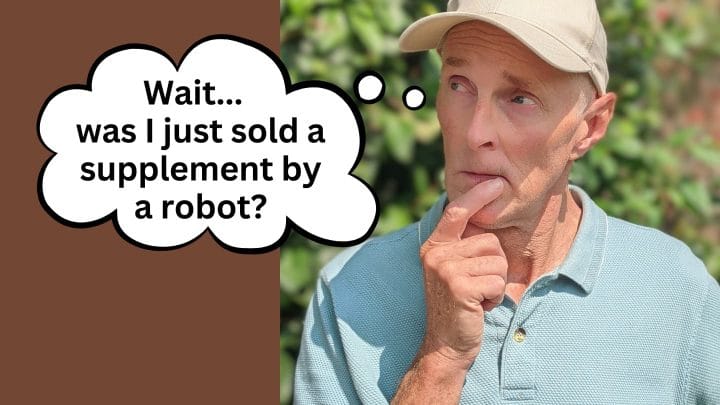
I had a customer service query about a nutritional product this week, and for the first few minutes, I was impressed. Whoever, or whatever, I was talking to was fast, sharp, and seemed to actually understand what I was asking. I remember thinking, “This is good service.”
Then the conversation drifted, as these things do, into a pitch. A slightly-too-smooth pivot toward a bundle deal, a formula recommendation that felt engineered rather than offered. And that’s when it clicked: I wasn’t talking to a person. I was talking to a voice program.
Nothing about the interaction itself had changed. The answers were the same quality before and after I noticed. But something in me had changed. I went from feeling pleased to distanced in the space of a single realisation to thinking of it as a “nano-instance” of trust collapsing. And oddly, my view of the product dipped too, even though the product itself hadn’t done anything. The company had lost my trust, not through action, but through the simple omission of revealing who or what I was actually talking to.
It Wasn’t the AI. It Was the Silence About the AI.
The issue wasn’t that I had spoken to an AI bot; many of us are comfortable with that, as long as we’re informed upfront. The problem was that I hadn’t been told, so I unknowingly placed a small amount of trust in something that wasn’t honest about its nature. That trust was then immediately exploited for a sales pitch.
It felt like a double betrayal: the undisclosed identity, and the ambush of a pitch that followed. Either misstep, on its own, might have slipped under the radar, but together they poisoned the whole exchange.
A Familiar Family of Disappointment
I don’t think this is a new feeling, even if the AI wrapper is. It’s the same jolt as discovering a glowing five-star review was written for a fee or that a “personally handwritten” thank-you note was mail-merged. In each case, competence isn’t the issue: the notes were still legible and the review still well-written. What breaks is the assumption that a human effort or a human voice was behind it. We don’t just want good service. We want to know what we’re dealing with while we’re dealing with it.
AI customer service may simply be the newest and most widespread version of this old disappointment, arriving at a moment when it’s happening to enough people, enough times, to start adding up.
Why Speed Backfired
There’s something almost perverse about it: the very speed that impressed me was also what made the eventual reveal cut deeper. A slower, more hesitant response might have tipped me off sooner, softening the blow or at least sparing me the disappointment of having been genuinely impressed. Instead, that competence bought a sliver of trust, which was then effectively spent on a sales pitch. Efficiency, rather than cushioning the deception, only made it land harder.
Is This Widespread, or Just Me?
The social media pushback against “AI slop” suggests I’m far from alone, but I suspect the customer-service version of this is quieter and slower-burning than the more visible complaints about AI-written listicles or synthetic images. Nobody screenshots a chatbot conversation and posts it in outrage over a mild sales pitch. But if a small, private erosion of trust like mine is happening across thousands of these interactions a day, it may not need to be loud to be consequential. It just needs to be cumulative.
The Wheels Aren’t Necessarily Coming Off, But the Road Might Get Bumpy
Admittedly, my first instinct was to predict the entire AI customer-service experiment imploding under its lack of transparency. That’s probably an overreaction after one run-in with a supplement company. What I can say more confidently is this: companies that deploy AI without disclosure or without keeping it honest once disclosed are mortgaging long-term trust for a short-term efficiency gain, whether they’ve calculated that cost or not. They don’t need to spark a wholesale collapse for the damage to show up; individual brands can quietly bleed goodwill from customers who sense, even fleetingly, that they’ve been misled.
Whether that accumulates into a reckoning for the industry or just settles into a recurrent irritation pattern that most people brush aside depends, I suspect, on whether disclosure feels like an afterthought or a default. My hunch is that most companies will correct missteps only when the price of inaction becomes too plain to overlook.
Saturday Morning Thoughts
Every Saturday, this space slows down for a moment – to sit with a question rather than rush past it. These are seven of the pieces readers have returned to most: on silence and performance, on work that stopped meaning anything, on the quiet ways modern life pulls us apart. If you’ve got a few minutes and a coffee, start here.
Saturday Morning Thought: Who Owns the Bucket of Moon Dirt?
Still Showing Up: The Retirement Crisis Nobody Wants to Talk About
Saturday Thought: Zeolite, the Romans, and the Myth I Almost Believed
Work Was Supposed to Mean Something
Saturday Morning Thought: The Loudest Thing You Can Do is Nothing
Saturday Morning Thought: Awareness of the Cage Doesn’t Open the Door
Saturday Morning Thought: The Quiet Breaking Point
More connected than ever. So why does it feel like nobody’s home?
The question that never comes up
Have we turned fun into a side hustle?
Waking Up to Orthosomnia: How Our Obsession with Perfect Sleep is Keeping Us Awake
The Nano-Instance That Changed My Mind: AI, Trust and Customer Service
Thanks for reading! If you’re curious about learning affiliate marketing and building your own online business, you can explore the platform I mentioned in this post. You can check out Wealthy Affiliate here and see how the training, tools, and community work together to help beginners get started.