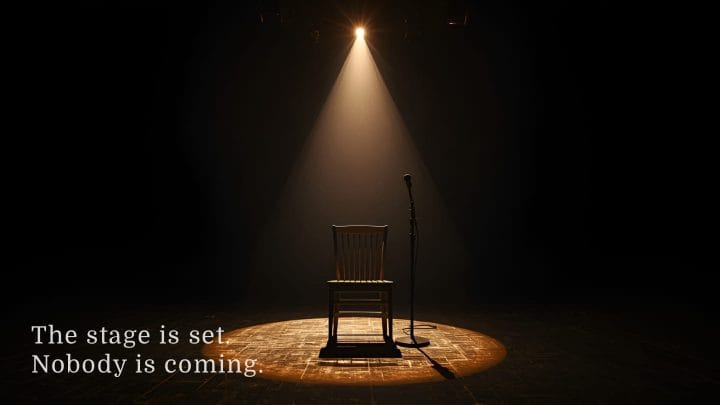
Going quiet online feels like freedom. But have we really left the stage or just changed our act?
Before I posted anything, I edited it. Not with filters or cropping but in my head, before my fingers moved. Is this worth sharing? How will this land? Will it be too much, or not enough? What if I phrase it wrong and it’s out there forever? The decision to post a photograph of a meal, a holiday, a milestone, or any of it came preloaded with a private tribunal that had to be cleared first. And even then, once it was out there, the quiet anxiety didn’t stop. It just changed shape.
Eventually, I stepped back from Facebook and Instagram. The relief was immediate and, I’ll admit, surprising in its completeness. No more performance reviews. No more measuring the entertainment value from my life before I’d finished living it. I’m a child of the mid-sixties – tail end of the boomers – and somewhere in my upbringing was a firm, unspoken rule: your business is your business. Social media had asked me to unlearn that entirely. Going quiet felt less like a choice and more like a homecoming.
I am, it turns out, not alone. A shared sentiment has taken hold on social media, defining the mindset of the generation that grew up within it. It travels under the phrase “Don’t let them know your next move.” No announcements until after the fact. People no longer share jobs they applied for, relationships they’ve started, flats they’re viewing, or plans they’re making. Protect your peace. Keep your cards close. Let the news arrive fully formed, or not at all.
We must recognise the genuine wisdom here before we overcomplicate it. Older millennials were the original crash-test dummies of the oversharing age. They announced relationships that collapsed publicly. They documented decisions that later haunted them in job interviews. They learnt, to their cost, that the internet has a long memory and a short attention span for context. What looks like candour in the moment can read as chaos a decade later. The retreat from broadcasting makes sense as a response to all of that.
For some of us who joined social media as adults, rather than growing up inside it, this instinct runs even deeper. It isn’t really about strategy at all. It’s a vague but persistent feeling that all this public self-disclosure was never quite right, that performing your life for an audience of acquaintances sits awkwardly against values formed well before the internet existed. The withdrawal is less a tactic than a return to something that felt more natural.
And yet. There is a version of this trend that is not a retreat from social media logic at all; it is social media logic at its most refined.
Watch carefully and you’ll see it: the person who announces, with some deliberateness, that they no longer announce things. There’s like a cultivated air of mystery, deployed as personal branding. The strategic silence that is not really silence, because silence, when performed, is still a performance. Withholding has become its own form of content. The mystique is the post.
This irony is far from minor. It points to something more uncomfortable: social media did not just change what we share. It changed how we think. It installed an audience inside our heads, and that audience does not leave simply because we deactivate an account. The years spent posting and scrolling conditioned us to see our lives as raw material, constantly editing our experiences for an imaginary audience. That reflex does not evaporate when the app is deleted. The editor remains in residence.
The question worth sitting with, then, is not whether to share or to withhold. It is whether the inner monologue has gone quiet too or whether we are still, even in our silence, playing to an imagined room.
Real liberation, if it exists, likely resembles a genuine loss of interest in the game rather than a curated disappearance. It is not about choosing to keep your next move secret but about genuinely stopping to think in terms of moves. That is harder than logging off. It may, in fact, be the work of years.
In the meantime, the most honest thing any of us can probably say is this: we have changed our behaviour. Whether we have changed our minds is another question entirely.
Saturday Morning Thoughts
Every Saturday, this space slows down for a moment — to sit with a question rather than rush past it. These are seven of the pieces readers have returned to most: on silence and performance, on work that stopped meaning anything, and on the quiet ways modern life pulls us apart. If you’ve got a few minutes and a coffee, start here.
The Nano-Instance That Changed My Mind: AI, Trust and Customer Service
Saturday Morning Thought: Who Owns the Bucket of Moon Dirt?
Waking Up to Orthosomnia: How Our Obsession with Perfect Sleep is Keeping Us Awake
Still Showing Up: The Retirement Crisis Nobody Wants to Talk About
Work Was Supposed to Mean Something
Saturday Morning Thought: The Loudest Thing You Can Do is Nothing
Saturday Morning Thought: Awareness of the Cage Doesn’t Open the Door
Saturday Morning Thought: The Quiet Breaking Point
More connected than ever. So why does it feel like nobody’s home?
The question that never comes up
Have we turned fun into a side hustle?
Saturday Thought: Zeolite, the Romans, and the Myth I Almost Believed
P.S. As a solopreneur and freelancer, I know the importance of “Plan B.” While these foundations changed my health, they also opened up a secondary path to income. If you’re a fellow “plate juggler” looking to monetize wellness alongside your current gig, check out the Collaborate page.