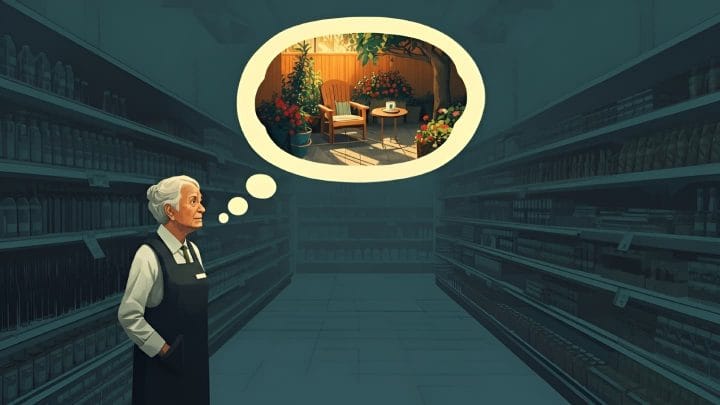
She is sixty-eight years old, and she is on her feet again. Margaret – not her real name, but it might as well be – starts her shift at six in the morning, stacking shelves at a supermarket in Coventry before the first customers arrive. Her knees ache. They have ached for years. She does not complain about the pain at work because she cannot afford to draw attention to herself and cannot afford to be perceived as slow, difficult, or a liability. She needs this job. She will need it next year, too. And probably the year after that.
This is not the retirement she imagined. But then, she could not have imagined the particular accumulation of losses that brought her here.
We have a story we tell about Baby Boomers, and it goes like this: they bought their houses for tuppence, watched the value triple while they slept, retired at sixty with gold-plated pensions, and now spend their twilight years cruising the Mediterranean and complaining about young people. It is a story with enough truth in it to feel satisfying and just enough laziness in it to do serious political damage.
Because the other story, the one we do not tell, goes like this…
Margaret left school at sixteen. She worked. She married, had children, and worked some more. When her mother’s dementia progressed, she cut her hours to become her primary carer. The state had already quietly decided unpaid family labour was an acceptable substitute for a functioning social care system, offering her nothing she could afford. She cared for her mother for four years. Four years of invisible work: unrecognised by the tax system, uncounted toward her national insurance, uncompensated, and undervalued – meaning she saved nothing for her future, as there was simply no money left over.
Then came the divorce. Then came the years of renting, late in life, watching what little she had trickle into a landlord’s pocket. Then came the cost-of-living crisis, which is a polite term for what happens when wages stagnate for a decade and energy bills do not.
She did not blow her retirement on avocados. She used it to survive.
The “lazy Boomer” stereotype does not just mislead – it does a specific kind of political work. It takes what is fundamentally a story about class and turns it into a story about generation. It sets a 28-year-old graduate against a 68-year-old shelf-stacker and tells them their interests are opposed when, in fact, they share the same enemy: a political economy designed to extract wealth upwards and call the results inevitable.
Austerity was not inevitable. It was a choice. A sovereign nation with a GDP of over £2.5 trillion chose, for fifteen years, to tell the public there was no money while simultaneously bailing out banks, awarding contracts to donors, failing to collect taxes from the offshore-structured holdings of non-domiciled billionaires, and finding several billion pounds for schemes like the Rwanda deportation policy that never deported anyone. There was money. There was always money. The question was always who it was for.
The answer, reliably, was not Margaret.
“There was money. There was always money.”
What has happened to retirement itself is worth naming plainly, because the language used to describe it is almost entirely dishonest.
A defined-benefit pension – the kind that is paid as guaranteed income based on your salary and years of service – was not abolished by economic necessity. It was abolished by employers who found it inconvenient, with the quiet acquiescence of governments who found the optics manageable. In its place came defined-contribution schemes, where the risk was transferred entirely onto the worker and where the outcome depended heavily on one’s ability to contribute consistently over decades. Which is to say, it had depended on always avoiding a sick parent, a divorce, a redundancy, a period of part-time work, or any of the other routine catastrophes of ordinary life.
The people who lost most were those whose working lives were already interrupted – disproportionately women, disproportionately those in the bottom half of the income distribution. Late Boomers, who came of age just as the old settlement was being dismantled, found themselves in a precarious situation before they had accumulated enough resources to weather it.
Now, we are told to celebrate the ‘new retirement’. Sunday supplements are obsessed with it: the 66-year-old who turned a passion for watercolours into a small Etsy business and the former teacher consulting from his kitchen table. Reinvention. Portfolio lives. Silver entrepreneurship. It is presented as liberation.
For some people, it genuinely is. But for Margaret, working past sixty-five is not a lifestyle choice dressed up in the language of entrepreneurship. It is economic compulsion dressed up in the language of choice. The state, having failed to provide adequate pensions, having dismantled social care, and having presided over a housing market that excluded millions from the asset wealth it simultaneously celebrated – the state would now like you to see her hustle as admirable.
It is not admirable. It is a scandal. And the fact that she still shows up, smiles at customers, and carries the weight of it without drama or complaint makes it an even bigger scandal.
The numbers support what individual lives make visible. The Pension Policy Institute estimates that millions of people in the UK are reaching retirement age with savings significantly below what they need. Women are particularly exposed, retiring with pension wealth roughly half that of men on average – a gap forged not by individual failure but by structural decisions about whose work counts and whose is discarded. Food bank use among older adults is rising. The number of over-65s in employment has grown substantially since the 2008 financial crisis and has not meaningfully fallen back.
And yet the political conversation about retirement remains focused almost exclusively on the triple lock – on whether Boomers are getting too much – rather than on how an entire cohort was allowed to fall into poverty in one of the world’s largest economies.
There is a version of this story where Margaret is the problem: another pensioner draining the system, another Boomer who didn’t plan properly, another person whose difficulties are ultimately her own responsibility. That version is comfortable for a certain kind of politics. It asks nothing of anyone with power.
Another version exists: Margaret represents the reckoning. Her aching knees and six o’clock starts are the accumulated consequences of every political choice made in her lifetime – the pensions stripped, the social care defunded, the wages suppressed, and the housing handed to capital. Her invisibility is itself a form of violence: no one writes about her, no one builds policies around her, and no one even uses her generation’s name without contempt.
She will be in again tomorrow. Early shift.
Still showing up. Still uncounted.
The retirement crisis is not coming. For millions of people in Britain, it is already here – and it looks nothing like the story we’ve been sold.
If this essay resonated with you – perhaps because you recognise something of your own circumstances in it – you might be exploring what alternatives actually look like. I write about organic living and have built a small income around it. It is not a magic solution, and I won’t pretend otherwise. But if the idea of working toward something that feels more purposeful and self-directed interests you, my Work With Me page has a short overview of how it works.
Saturday Morning Thoughts
Every Saturday, this space slows down for a moment — to sit with a question rather than rush past it. These are seven of the pieces readers have returned to most: on silence and performance, on work that stopped meaning anything, and on the quiet ways modern life pulls us apart. If you’ve got a few minutes and a coffee, start here.
Saturday Morning Thought: Who Owns the Bucket of Moon Dirt?
Waking Up to Orthosomnia: How Our Obsession with Perfect Sleep is Keeping Us Awake
Still Showing Up: The Retirement Crisis Nobody Wants to Talk About
Work Was Supposed to Mean Something
Saturday Morning Thought: The Loudest Thing You Can Do is Nothing
Saturday Morning Thought: Awareness of the Cage Doesn’t Open the Door
Saturday Morning Thought: The Quiet Breaking Point
The Nano-Instance That Changed My Mind: AI, Trust and Customer Service
More connected than ever. So why does it feel like nobody’s home?
The question that never comes up
Have we turned fun into a side hustle?
Saturday Thought: Zeolite, the Romans, and the Myth I Almost Believed
P.S. As a solopreneur and freelancer, I know the importance of “Plan B.” While these foundations changed my health, they also opened up a secondary path to income. If you’re a fellow “plate juggler” looking to monetize wellness alongside your current gig, check out the Collaborate page.