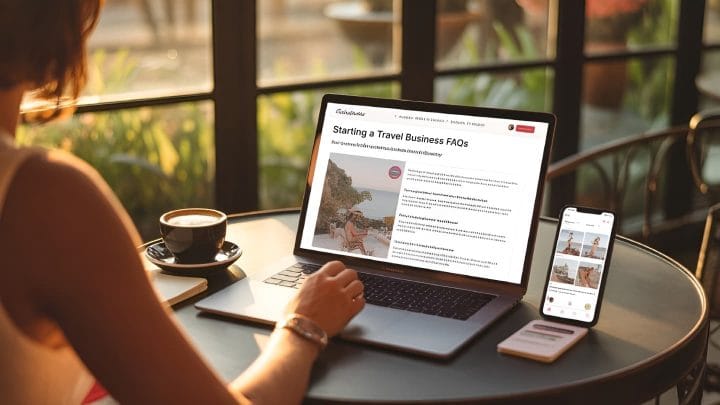
Twenty of the most common questions about building a travel content business – answered plainly, honestly, and without the hype. From getting started to going official, from income expectations to the platform that teaches it all.
The Turn Your Passion Into a Business series covers the full architecture of a travel content business across ten posts. But a series that thorough naturally leaves questions in its wake – the “yes, but…” moments that sit between reading something and actually starting it.
This FAQ post exists to answer those questions. Twenty of the most common ones, organised into five clusters, answered as honestly and practically as possible. Where a full post in the series covers a topic in depth, you’ll find a link to it – because a two-sentence answer is sometimes all you need, and sometimes you need the full picture. Both are here.
Getting Started
The questions in this cluster are the ones most people ask before they commit to anything. They’re the “am I even the right person for this?” questions – and the honest answer, in almost every case, is yes. Here’s why, and what the first steps actually look like.
. Do I need to have travelled extensively to start a travel guide business?
No – and this is one of the most liberating things to understand early. A travel guide business doesn’t require a passport full of stamps. It requires genuine knowledge of a specific niche – which could be a single country, a single travel style, a single type of experience, or even a single region you know better than most. Depth matters more than breadth.
The travel creator who has spent three months living in rural Portugal knows things about slow travel in that country that someone who has visited forty countries briefly simply doesn’t. That specific, earned knowledge is your competitive advantage – not the number of places you’ve been. Post 2 on building your brand identity covers how to define your niche around what you genuinely know.
. How do I choose a travel niche if I have multiple interests?
Start with the intersection of what you know most deeply, what you’re most passionate about, and what an identifiable audience is actively searching for. If you love food travel, adventure hiking, and slow travel in Europe – that’s three potential niches, not one. The temptation is to cover all three. The smarter move is to start with one, build authority there, and expand later from a position of established credibility.
A useful test: which of your travel interests do you talk about most when a friend asks for advice? That’s usually the one where your knowledge is deepest and your voice is most natural. The brand identity post includes a brand discovery framework that helps you work through exactly this decision.
. Do I need technical skills to build a travel website?
No. The technical barrier to building a professional travel site is lower than it has ever been. Modern website platforms handle the complexity – hosting, security, design, mobile optimisation – so you can focus on the content. If you can write an email and use a word processor, you have the technical skills required to start.
The learning curve exists, but it’s measured in hours rather than months. Wealthy Affiliate specifically addresses this – their training walks complete beginners through building a site from scratch, step by step, without assuming any prior technical knowledge.
. How much does it cost to start a travel guide business?
Significantly less than most people expect. A domain name costs approximately £10–15 per year. Hosting starts from around £3–10 per month on entry-level plans. A free WordPress theme, free design tools like Canva, and a free email marketing account round out the essentials. A realistic startup budget for the first year is under £150.
Compare that to almost any other business model – retail, food service, franchising – and the capital requirement is remarkably low. The investment is primarily time, not money. Wealthy Affiliate’s free plan lets you start building without spending anything at all, which makes it a particularly sensible starting point.
. How long does it take before I start seeing results?
Honestly, longer than most people hope and shorter than most people fear once they understand what “results” means at each stage. The first affiliate commission can arrive within weeks of publishing. Meaningful, consistent traffic typically takes six to twelve months of consistent publishing. A reliable, significant income generally takes eighteen months to three years.
The compound effect is real but it’s not instant. The sites that reach significant income are almost universally the ones that kept publishing consistently through the early months when it felt like nobody was reading. Post 10 on scaling covers the compound effect timeline in detail – including what to expect at six, twelve, and twenty-four months.
Income and Money
The questions most people are thinking about but feel slightly awkward asking. Income from a travel content business is real, achievable, and genuinely varied – but it’s also honest work that takes time to build. Here are straight answers to the money questions.
. How much can a travel blog realistically earn?
The range is enormous – from a few pounds a month in the early stages to five and six-figure annual incomes for established niche sites. A realistic expectation for a well-structured travel site after twelve months of consistent publishing is a modest but real affiliate income – enough to cover hosting costs and begin to grow. After two to three years, with multiple income streams active, a full-time income becomes genuinely achievable for focused, consistent creators.
The income ceiling in travel content is high because travel purchases are high-value – hotel bookings, multi-day tours, travel insurance, flights. A single well-placed affiliate recommendation can generate more commission than a hundred clicks on a display ad. Post 5 on affiliate partnerships explains the income mechanics in detail.
. How does affiliate income actually get paid – and how often?
Each affiliate programme has its own payment schedule and minimum threshold – but most major travel affiliate platforms pay monthly, via bank transfer or PayPal, once your balance exceeds a minimum amount (typically £25–£50). Some programmes pay on a 30 or 60-day delay to account for booking cancellations, which is standard practice in travel given the refundable nature of many bookings.
Your affiliate dashboard tracks clicks, conversions, and earnings in real time – so you always know what’s pending. The practical advice is to join programmes, start publishing content with affiliate links, and check your dashboard regularly without obsessing over it in the early months. The numbers grow as the content library grows.
. Do I need a lot of traffic before I can start earning?
No – and this is an important distinction. Affiliate income is driven by intent, not volume. A hundred highly targeted readers who land on your site while actively planning a trip to your niche destination are worth far more than ten thousand passive social media followers who briefly saw your post. A small, focused, trusting audience in the right niche can generate meaningful affiliate income from relatively modest traffic.
Display advertising is the exception – ad networks like Mediavine require 50,000 monthly sessions before they’ll accept you. But affiliate income, digital product sales, and direct tour partnerships all become viable at much smaller traffic levels, particularly in high-value travel niches.
. Can I earn from a travel site if I’m based in the UK rather than the US?
Absolutely. The major travel affiliate programmes – Booking.com, GetYourGuide, Viator, World Nomads, Amazon Associates – are all globally available and pay regardless of where the creator is based. Your audience’s location matters more than yours: a UK-based creator writing about European travel for a UK audience is very well positioned, since UK travellers are among the highest-spending in the world.
The only practical consideration is tax treatment of affiliate income – which varies by territory. Post 9 on going official covers the UK self-assessment process and what declaring online income looks like for a sole trader.
. Is Wealthy Affiliate free, and what do you get on the free plan?
Yes – Wealthy Affiliate has a genuinely free starter plan, no credit card required. The free plan includes access to the core training, the ability to build a website, and entry to the community. It’s a meaningful starting point rather than a stripped-down teaser – enough to understand how the platform works and begin building before deciding whether to upgrade.
The Premium plan unlocks the full training library, advanced tools, hosting for multiple websites, and deeper community access. For anyone serious about building a travel business rather than just exploring the idea, Premium is where the full system becomes available. But the free plan is the right starting point – build something, experience the platform, then decide.
The travel businesses that earn real income aren’t built by people who waited until everything was perfect. They’re built by people who started imperfectly and kept going long enough for the compound effect to arrive.
Time and Effort
The most practical cluster – because the gap between “this sounds great” and “I’m actually doing it” is almost always about time. Here’s what the time investment actually looks like, what’s realistic alongside a full-time job, and what the most common mistake costs people in terms of wasted effort.
. How many hours a week does building a travel business actually take?
At the start – as little as five to ten hours a week produces meaningful progress. One well-written post per week, a Pinterest pin, an email to your small but growing list. That’s achievable on evenings and weekends without sacrificing everything else. The time investment grows as the business grows – but so does the return, which changes the calculation significantly.
The trap to avoid is the all-or-nothing mindset – the belief that you need twenty hours a week or it’s not worth starting. Five focused, intentional hours a week, applied consistently over two years, builds something real. Twenty frantic hours for three months and then nothing builds nothing.
. How often do I need to publish new content?
Consistency matters more than frequency. One post per week is a strong target that most solo creators can sustain. One post per fortnight is entirely viable and still builds meaningful authority over time. What doesn’t work is bursts – ten posts in a month followed by six weeks of silence – because it signals inconsistency to both search engines and readers.
The practical advice is to choose a publishing rhythm you can genuinely sustain for two years, not the most ambitious one you can manage for two months. Post 3 on content strategy includes a four-week content calendar that balances different content types within a sustainable weekly rhythm.
. Can I build a travel business alongside a full-time job?
Yes – and in many ways, having the financial security of a full-time job while building makes the early stage easier. You’re not dependent on the site’s income to pay rent, which means you can make better long-term decisions rather than chasing short-term revenue before the foundation is properly built. Many of the most successful travel content creators built their sites alongside jobs for one to two years before the income justified going full-time.
The key is protecting and scheduling your creation time, treating those five or ten hours a week as a genuine commitment rather than something you fit in when nothing else is happening. Evenings, early mornings, and weekend blocks are all viable. Sporadic “whenever I get around to it” isn’t.
. What’s the biggest mistake new travel content creators make?
Writing for themselves rather than for their reader. It’s the most natural mistake to make, you’re excited about a destination, you write what you want to say about it, and you publish it. But if nobody is searching for what you wrote, nobody will find it. Content that serves your reader’s actual questions and planning needs, not just your enthusiasm for a place, is what builds traffic, trust, and income.
The second most common mistake is stopping too soon. Almost every travel site that fails, does so not because the content was bad but because the creator stopped publishing before the compound effect had time to arrive. Post 3 on content strategy and Post 4 on SEO both address how to write content that serves reader intent rather than just personal enthusiasm.
Technical and Practical
The questions that sit behind “I’d love to do this but I don’t know how any of it works.” The good news is that the technical side of a travel content business is consistently more accessible than it appears from the outside. Here’s what you actually need to know.
. What platform should I build my travel site on?
WordPress is the clear recommendation for a travel content business built for the long term. It powers over 40% of the entire web, has an unmatched ecosystem of plugins and themes, gives you full ownership and control of your site, and is the platform that SEO and affiliate marketing best practices are built around. The learning curve is real but modest – most people are comfortable with the basics within a week.
Free platforms like Blogger or Wix are tempting because they’re easier to start – but they involve building on rented land, with limited customisation, weaker SEO capability, and no real ownership of what you create. WordPress, self-hosted on a reputable host, is the right foundation for a real business. Wealthy Affiliate includes managed WordPress hosting as part of its platform.
. Do I need to understand SEO before I start writing?
You need to understand the basics – enough to write with your reader’s search intent in mind rather than publishing into a void. The good news is that travel SEO basics are genuinely learnable in an afternoon, and applying them from your first post means you’re building authority from day one rather than retrofitting an SEO strategy onto content that wasn’t designed for it.
You don’t need to master technical SEO. You need to understand keyword intent, write descriptive titles and headings, give every image an alt text, and link between your own posts naturally. That’s it to start. Post 4 on SEO for travel sites covers all of this in plain English without jargon.
. What’s the difference between a travel blog and a travel guide business?
A travel blog is a personal record, it publishes what the creator wants to say, when they want to say it, for an audience that may or may not find it. A travel guide business publishes content strategically, written around what an audience is actively searching for, structured to earn through affiliate links and digital products, marketed through a deliberate system, and run with the discipline of a real business rather than the spontaneity of a hobby.
The distinction isn’t about size or income, it’s about intention. A travel guide business can be run by one person with a modest audience. But that person approaches content creation, SEO, monetisation, and marketing with a business mindset rather than a hobbyist one. That mindset shift is the most important thing this entire series is trying to convey.
. Do I need social media to succeed with a travel site?
No – but it helps significantly, and Pinterest in particular is close to essential for travel content. Pinterest functions as a visual search engine rather than a social platform, and travel is one of its highest-performing content categories. A well-pinned post can drive consistent traffic for years from a single image, which makes it the most efficient social channel for a content-driven travel business.
Instagram is valuable for brand building and discovery but not a primary traffic driver to your site. Facebook Groups can be excellent for niche community building. You don’t need to be on every platform – you need to be consistent on the one or two that serve your specific audience. Post 8 on marketing covers the social and email strategy in full.
A Practical Note on Tools
The tools required to run a travel content business are fewer and cheaper than most people expect. WordPress for your site. Canva for graphics. Google Search Console for SEO insights. Mailchimp or MailerLite for email. A keyword research tool – even the free version of Ubersuggest or Google’s own tools to start. That’s a complete toolkit for under £20 a month, most of which has a usable free tier.
Wealthy Affiliate – Your Questions
Wealthy Affiliate has been recommended throughout this series at the natural points where the platform genuinely addresses what a travel content creator needs. These questions give an honest, direct answer to what the platform is, what it teaches, and how it differs from other options – so you can make an informed decision rather than a blind one.
. What exactly does Wealthy Affiliate teach, and is it relevant to travel specifically?
Wealthy Affiliate teaches the full system of building a content-driven affiliate business – website creation, SEO, content strategy, keyword research, and affiliate marketing – through a structured training programme designed for beginners. It’s not travel-specific in its content, but it’s entirely applicable to travel because the underlying model – build an authoritative niche site, create content your audience searches for, monetise through affiliate partnerships – is exactly the model a travel guide business uses.
Think of it as the infrastructure training. The series on this blog gives you the travel-specific knowledge and context. Wealthy Affiliate teaches you how to build the platform that content sits on, how to optimise it for search, and how to connect it to affiliate income – with live weekly training, a searchable library of lessons, and a community of members building the same kind of business who can answer your specific questions at any hour.
. How is Wealthy Affiliate different from other online business platforms?
Three things set it apart meaningfully. First, it bundles training, hosting, and community into a single platform, rather than requiring you to piece together a course from one provider, hosting from another, and support from a forum somewhere else. Second, the community is genuinely active and experienced, thousands of members at various stages of building, with a culture of honest help rather than hype. Third, the training is practical and implementation-focused rather than theoretical, you build your site as you learn, which means you leave each lesson with something real rather than just notes.
What it isn’t is a get-rich-quick scheme or a shortcut. The platform is very clear, and the community reinforces, that building a real online business takes time, consistency, and genuine effort. The value is in having the right training, tools, and support alongside you while you do that work, rather than figuring it all out alone.
The Complete Series – All Ten Posts
This FAQ post sits alongside the full Turn Your Passion Into a Business series. If a question here has pointed you toward a topic you want to explore in depth, the series covers every one of them in full. The complete series guide gives you an overview of all ten posts with links to each one – the right starting point if you’re new to the series or want to read it in sequence.
Ready To Stop Wondering and Start Building?
Wealthy Affiliate gives you the training, tools, hosting, and community to build a real travel content business — free to start, no credit card required.
Free to join. No credit card required. Cancel anytime.