For centuries, the recipe for a good night’s sleep was admirably simple: a dark room, a cool breeze, and a relatively quiet mind. Today, it apparently requires a wrist-worn biometric sensor, a subscription-based health app, and your willingness to stare at a colour-coded sleep score before even having your morning tea. In modern Britain, we have transformed our most passive human function into a metric-driven second job – one with no sick pay, no annual leave, and a demanding performance review at 6 am.
A new word has crept into the clinical vocabulary to describe what happens next: orthosomnia. It sounds like something a Victorian physician might diagnose after too much port, but it is entirely contemporary – the anxiety that arises from trying to achieve a perfect night’s sleep. Coined by researchers in the United States and rapidly adopted by anyone who has ever jabbed furiously at a wellness app demanding to know why their REM cycle was “suboptimal”, orthosomnia is the gift we didn’t ask for, brought to us by the same technological optimism that gave us smart fridges and algorithmically curated playlists of rain sounds.’
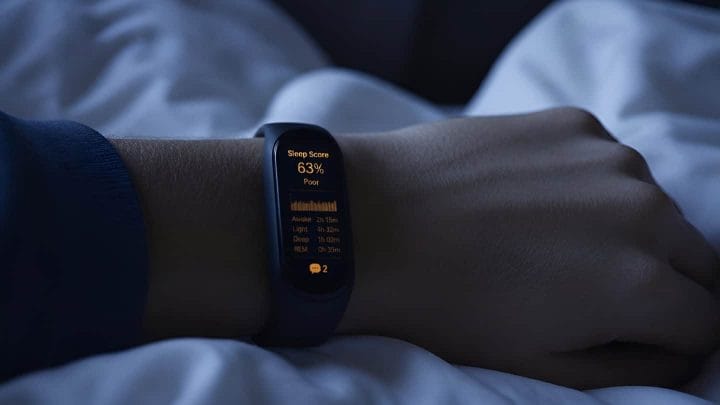
The paradox, of course, is magnificent in its cruelty: the data demands you sleep well, so you go to bed determined to deliver. You have already checked your recovery score, noted your slightly elevated resting heart rate, and read the app’s cheerful notification informing you that you are operating at sixty-three per cent of your optimal capacity. There is nothing quite like having a device count your steps to the biscuit tin while telling you that you are basically running on fumes.
I speak from experience. For a period of approximately eighteen months, I wore a fitness tracker to bed with the earnest dedication of a man who had genuinely confused self-care with self-surveillance. Every morning, before the kettle had even boiled, I would check my sleep report with the grim focus of a surgeon reviewing test results. Had I achieved sufficient deep sleep? Were my sleep stages properly distributed? Why had I, at 2:47am on a Tuesday, apparently registered a stress spike that the app classified as “notable”?
(It was, I later concluded, because the neighbour’s cat had jumped on me. The cat was not available for comment.)
The reports grew more elaborate. There were graphs. There were benchmarks against “peers of my age and gender“. There were gentle but pointed suggestions that I might consider a magnesium supplement, a gratitude journal, and a strict screen-free policy after nine o’clock – offered by a device that was itself a screen, worn on my body, and monitored at all times. The irony was apparently invisible to the algorithm.
What the tracker never measured was the cumulative psychological cost of all this scrutiny. As I lay in bed, I became increasingly aware that I was being assessed. That sleep, an ancient, democratic, blissfully unconscious act humans have performed without instruction manuals since the Pleistocene, had been reduced to a task I could easily fail at. And fail I did, repeatedly, in the specific way that only anxious perfectionists can: by trying with such intensity that the effort itself became the obstacle.
The scientific literature is catching up with what many of us discovered empirically in our darkened bedrooms. Researchers at Rush University in Chicago identified orthosomnia as a genuine clinical phenomenon after observing patients who presented with insomnia directly attributable to their obsessive monitoring of sleep-tracker data. Patients were, in effect, losing sleep over their sleep data. The trackers, meanwhile, are not even particularly reliable narrators. Studies have found that consumer wearables vary considerably in their accuracy – particularly for measuring sleep stages – meaning that the merciless judgement they deliver each morning may be, in statistical terms, largely fictional. You might have slept beautifully. The algorithm simply chose not to notice.
There is something very specifically British about our adoption of this technology. We were already, as a nation, somewhat conflicted about sleep – too Protestant to regard it as an unambiguous pleasure and too stoic to admit when it was going badly. “I only need five hours,” we would announce at parties, as though sleep deprivation were a personality trait to be proud of, somewhere between being handy at DIY and not complaining about the weather. Fitness trackers have not resolved this ambivalence. They have merely redirected it into a new channel: instead of boasting about how little sleep we need, we now compete over how efficiently we sleep. The goal posts have moved, but the performative anxiety remains entirely intact.
I binned the tracker in the end. Not dramatically – there was no ceremony, no formal farewell, no cathartic moment of hurling it into the garden (though I won’t pretend the thought didn’t cross my mind). I simply stopped wearing it, left it in a drawer, and waited to see what happened.
What happened was I started sleeping better—not immediately or perfectly. Perfection, I had begun to suspect, was precisely the problem. But gradually, unmonitored sleep crept back into something that resembled its natural shape. Without the nightly audit, the bedroom became, once again, a room for sleeping in rather than a laboratory for measuring whether I was sleeping correctly.
For good measure, I also stripped my phone of several social media applications that had been contributing their own ambient hum of distraction and mild dread to my pre-sleep routine. No more doomscrolling into the small hours; no more algorithmic content engineered by people in California to keep my eyeballs open and my dopamine receptors faintly dissatisfied. The phone, reduced to its role as an alarm clock, became considerably less interesting to look at in bed. Reader, I slept.
None of this is to suggest that wearable technology is without value – for people managing genuine health conditions, continuous monitoring can be genuinely life-changing. Nor is it to romanticise some pre-technological golden age of sleep, when people presumably lay awake worrying about harvests and bears rather than biometric scores. The issue is not the data itself, but what we do with it: whether we use it as a tool or allow it to become a tyrant.
The crux of orthosomnia is that sleep, to remain sleep, must be allowed to escape the logic of productivity. It is not a performance. It cannot be optimised like a business metric or a production line; trying to force sleep into a system of efficiency and control only makes it harder to achieve. Fundamentally, it is the act of surrendering consciousness, control, and the relentless impulse to measure, improve, and compete. The moment you turn it into a task, you have already, in a very real sense, failed at it.
There is a fine irony in the fact that the technology designed to help us rest better has generated, for a significant portion of its users, a brand-new category of nocturnal anxiety. We set out to sleep like athletes and ended up lying awake like accountants. We wanted peak performance and got performative exhaustion instead.
The most radical act of sleep hygiene available to many of us may simply be this: put the tracker in the drawer, put the phone on the other side of the room, and trust – as every human being who ever lived trusted, before the invention of the wristband with the little graphs – that your body knows, broadly speaking, what it is doing in the dark.
It has had rather a lot of practice.
Orthosomnia: an excessive preoccupation with achieving optimal sleep, often induced or worsened by the use of consumer sleep-tracking technology.
Saturday Morning Thoughts
Every Saturday, this space slows down for a moment — to sit with a question rather than rush past it. These are seven of the pieces readers have returned to most: on silence and performance, on work that stopped meaning anything, on the quiet ways modern life pulls us apart. If you’ve got a few minutes and a coffee, start here.
Saturday Morning Thought: Who Owns the Bucket of Moon Dirt?
Still Showing Up: The Retirement Crisis Nobody Wants to Talk About
Saturday Thought: Zeolite, the Romans, and the Myth I Almost Believed
Work Was Supposed to Mean Something
The Nano-Instance That Changed My Mind: AI, Trust and Customer Service
Saturday Morning Thought: The Loudest Thing You Can Do is Nothing
Saturday Morning Thought: Awareness of the Cage Doesn’t Open the Door
Saturday Morning Thought: The Quiet Breaking Point
More connected than ever. So why does it feel like nobody’s home?
The question that never comes up
Have we turned fun into a side hustle?
Waking Up to Orthosomnia: How Our Obsession with Perfect Sleep is Keeping Us Awake
P.S. As a solopreneur and freelancer, I know the importance of “Plan B.” While these foundations changed my health, they also opened up a secondary path to income. If you’re a fellow “plate juggler” looking to monetize wellness alongside your current gig, check out the Collaborate page.