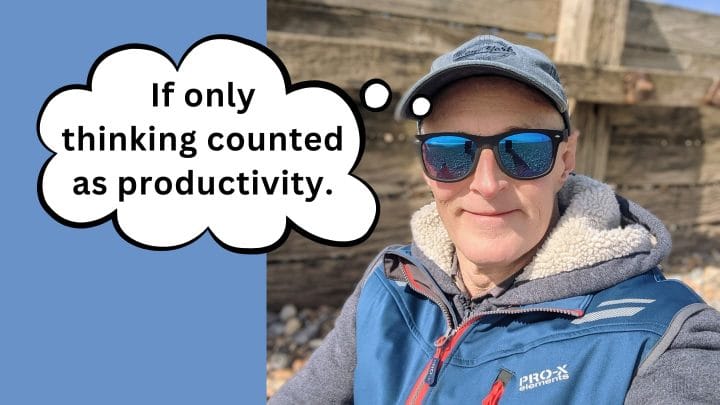
We’re supposed to be working towards leisure. So why does everything around us seem designed to prevent it?
Here’s something I’ve been sitting with. We all know the received wisdom: work hard, be productive, and eventually — in retirement, on holiday, somewhere down the line — you’ll get to do the things that actually matter. Leisure, as Aristotle had it, is the point. Work is just how you get there.
Fine. Except that if you look at how our economy actually works, and how our incompetent politicians actually talk, the message is almost the exact opposite. The goal isn’t to help people reach leisure. The goal seems to be to make sure as many people as possible are in paid work, for as many hours as possible, for as long as possible. And anyone who isn’t? They need to be nudged, incentivised, or if necessary, forced back into it.
Nobody really explains why. It just goes without saying.
Why are politicians so obsessed with jobs?
Think about how politicians of every stripe talk about the economy. It’s always about jobs. Creating jobs, protecting jobs, getting people back into work. It functions almost like a moral argument — as if being employed is what makes a person legitimate, and not being employed is something close to a character flaw.
Which is odd, when you step back. We’ve had centuries of technology specifically designed to reduce the amount of human labour required to get things done. Each generation is more productive than the last. So logically, we should be working less. Instead we’re working more anxiously, more precariously, and thanks to smartphones, more or less continuously.
Keynes predicted in 1930 that by now we’d probably be working around fifteen hours a week, spending the rest of our time on arts, friendship, and thought. He got the productivity gains right. He got the rest completely wrong.
The question of why that is — why we didn’t take the gains as time — is one that almost never gets asked in mainstream political debate. It’s treated as though the current arrangement is just the natural state of things, rather than a choice that was made, and keeps being made, on our behalf.
The things that matter don’t count
What bothers me more, though, is what happens to the activities that don’t come with a pay cheque. Looking after your children full-time. Caring for an elderly parent. Volunteering. Making art. Maintaining the kind of slow, unglamorous community glue that holds places together — the local group, the neighbour who checks in, the person who organises things for no reward.
None of that counts, in the economic sense. Worse — it’s actively penalised. Step out of paid work to care for someone, and you fall behind on your pension, your National Insurance record, and your career. That has certainly been my experience in the void aftermath of caring for both parents in their final years. The signal the system sends is pretty clear: if you can’t attach a price to it, it isn’t valuable. And if it isn’t valuable, don’t expect us to protect you for doing it.
There’s a circular logic at work here that’s quite hard to see until you look for it. The market decides what counts as contribution. Unpaid work doesn’t appear in the market. So unpaid work doesn’t count as contribution. So the people doing it don’t deserve economic security. Round and round it goes.
Who does this actually suit?
I don’t think this is a conspiracy. But it’s worth asking, plainly, who benefits from a system where people have no real choice but to sell their labour. The answer is: those who buy it. Workers who can’t afford to step back — who have no cushion, no alternative, no community to fall back on — are workers who will accept worse terms. The compulsory nature of participation keeps the price of labour competitive.
Politicians who speak passionately about the dignity of work are often entirely sincere. They’ve just absorbed a framework without examining where it came from or whose interests it serves.
So what would we ask instead?
The question I keep coming back to is the most basic one: what’s an economy actually for? If the answer is “for people to live well,” then our current setup takes a remarkably roundabout route to get there. It destroys the conditions for a good life at every turn, and then sells fragments of it back — holidays, subscriptions, wellness weekends — at a considerable markup.
A politics willing to ask that question honestly might look quite different from what we have. It might treat time as something valuable in itself, not just as a resource to be filled with productive activity. It might take seriously the idea that a society where people have room to think, to care for each other, to make and tend and simply be present — is probably a better society by most measures that actually matter.
It’s not that this is a radical idea. It’s that it never seems to occur to anyone to put it on the agenda. And that, in itself, is worth noticing.