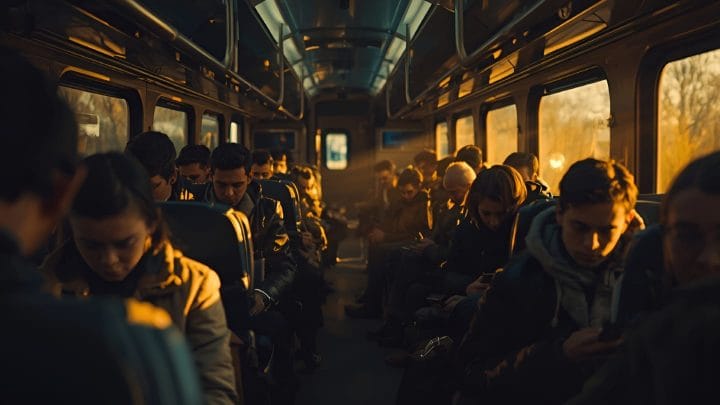
On trains, earbuds, and the slow disappearance of accidental conversation.
The carriage was full, and it was completely silent. Not the companionable silence of people comfortable in each other’s company – but the sealed, private silence of dozens of individuals who had each retreated into a screen-shaped room of their own construction. No laughter. No bickering. No strangers tentatively trading observations about the weather or the delay. Just the low hum of the train, and the faint, tinny bleed of audio from earbuds worn like a polite signal: do not disturb.
It would be easy to call this rude. It would be easier still to call it progress – everyone entertained, no awkward small talk forced upon the unwilling. But sit with it a little longer and something more unsettling comes into view. What we are watching, in carriages and waiting rooms and lifts across the world, is not simply a preference for phones over people. It is the gradual atrophying of a skill we never thought we needed to practise: the ability to simply be with strangers.
“Conversation was never really about information. It was about the risk — the tiny, exhilarating gamble of not knowing where a sentence might lead.”
Humans are, by every measure we have, a social species. We evolved telling stories around fires, reading faces across market squares, negotiating trust through tone and eye contact and the subtle theatre of a shared meal. The train carriage – a metal box hurtling through the countryside with an arbitrary selection of fellow humans – was, for most of modern history, a small enforced rehearsal of that ancient skill. You were thrown together. You coped. You occasionally surprised each other.
The smartphone did not murder conversation. It simply made opting out frictionless. Where once you had to actively avoid someone – bury yourself in a newspaper, develop a sudden fascination with the passing fields – you can now disappear entirely while remaining physically present. The earbud is the perfect alibi: even if you are watching a man trip over a cat for the fourteenth time, you look as though you are engaged in something important and interior. Nobody interrupts a person who looks that absorbed.
What troubles me is not the distraction itself. Every generation has had its escapes: novels, newspapers, the Walkman. What is different now is the scale, and the seamlessness. The smartphone offers an inexhaustible alternative to the present moment. There is always something more optimised for your attention – more funny, more outrage-inducing, more precisely calibrated to the particular shape of your brain – than the unremarkable human sitting opposite you. In that competition, the unremarkable human loses every time. And we all, quietly, become a little less practised at finding them remarkable.
“Boredom was the gateway drug to conversation. We have abolished boredom, and we wonder why nobody talks anymore.”
There is something to grieve here, even if we resist the easy nostalgia. The chance encounter that becomes a friendship. The offhand remark from a stranger that reframes a worry you have been carrying for weeks. The argument about football that somehow ends in an exchange of numbers. These things still happen, but they require a crack in the armour – a dead phone, a forgotten podcast, a moment of accidental eye contact before anyone can look away. They require, in short, the willingness to be briefly bored, briefly exposed, briefly human in public.
Perhaps we will relearn it. Perhaps, as the noise of infinite content eventually exhausts us, we will rediscover the strange pleasure of a conversation that goes nowhere in particular. Or perhaps the silent carriage is simply what we are now: millions of people, pressed briefly together, each sealed inside a world that asks nothing of them and offers everything.
The train pulls into the station. Everyone files out without a word. Somewhere behind us, the seats are still warm.