What Humans and Whales Have in Common (Hint: It’s Not Swimming)
Who knew humans and some whale species were in such exclusive company? As someone who recently dove into the Up One podcast episode on menopause, I have to admit—this wasn’t my usual area of deep dive. But in the health and longevity space, menopause comes up constantly in conversations and customer questions. So I listened, learned, and honestly? I had no idea how much I didn’t know.
Here’s what stuck with me from a guy’s perspective.
The Evolutionary Mystery: Thank You, Mitochondrial Eve?
Menopause is biologically bizarre. Humans and a handful of whale species are the only animals that experience it. Most species reproduce until death, but we have this strange biological off-switch that happens decades before end of life.
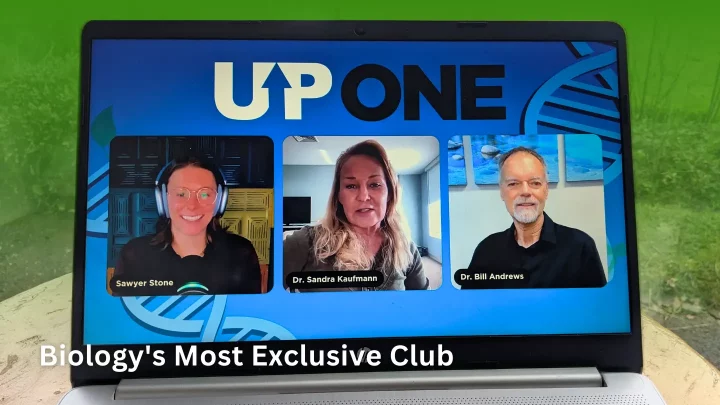
According to Dr. Bill Andrews, one of the podcast guests, there’s no clear evolutionary advantage to menopause. It might just be… random. He half-jokingly suggests we can trace it all back to “Mitochondrial Eve”—one woman who lived 150,000 years ago. Her unique biology got passed down to every human alive today.
Thanks, Eve. 🙃
What Menopause Actually Is (Beyond the Hot Flash Clichés)
Dr. Sandra Kaufman, a longevity physician and the episode’s expert guest, puts it simply: menopause is ovarian failure.
Think of it as “ovarian retirement.” Around age 48-50 (though it varies widely), the ovaries stop producing eggs. More importantly, they stop producing the master hormones estrogen and progesterone in meaningful quantities.
This one hormonal shift is like firing the foreman of a complex factory. Systems throughout the body start glitching in different ways:
The Domino Effect of Declining Estrogen
The brain’s thermostat goes haywire → Hot flashes happen because estrogen helps regulate the hypothalamus, your body’s temperature control center. When estrogen drops, the “thermoneutral zone” (the range where your body feels comfortable) shrinks dramatically.
Bone remodeling slows down → Osteoporosis risk jumps. Estrogen inhibits osteoclasts (cells that break down bone) and supports osteoblasts (cells that build bone). Without it, you’re breaking down more than you’re building up.
Cholesterol processing gets messy → LDL cholesterol can spike. Estrogen normally helps regulate LDL receptors on cell surfaces. When it drops, your body becomes less efficient at clearing “bad” cholesterol.
Cellular energy dips → Crushing fatigue and brain fog. Estrogen regulates PGC-1 alpha, a crucial protein for mitochondrial function (your cells’ power plants). Less estrogen = less energy production.
Sleep systems get disrupted → Welcome, insomnia. This is actually a multi-layered problem involving not just hormones, but also declining NAD levels and sirtuins (proteins that regulate cellular processes).
And yes, the podcast confirmed: men get brain fog too—so we can’t blame everything on menopause.
Why Symptoms Vary So Dramatically
Some women sail through with barely a hot flash. Others experience 7-10 hot flashes daily for over a decade. Some gain weight despite no dietary changes. Others develop tinnitus or frozen shoulder seemingly out of nowhere.
Why such variation?
According to the experts, it comes down to:
- Genetics – Your baseline hormone levels and receptor sensitivity
- Overall health – Healthier, more physically active women tend to have later menopause and fewer severe symptoms
- The magnitude of change – Dr. Kaufman theorizes that the delta (how dramatic the drop in hormones is) matters more than the absolute levels
Interestingly, women who are obese often have worse symptoms, possibly because they have higher baseline estrogen (fat tissue produces estrogen). When levels drop, the change is more dramatic.
The Clock Nobody Understands
Here’s where it gets really interesting: there seems to be some kind of biological clock controlling when menopause happens, but nobody knows what it is.
Dr. Andrews pointed out that the age distribution of menopause doesn’t follow patterns you’d expect if it were purely driven by environmental factors like oxidative stress or inflammation. There’s too much consistency across different populations and circumstances.
It’s not tied to:
- When you first got your period
- Circadian rhythms or moon cycles (despite the 28-day menstrual cycle)
- Telomere biology (at least not in ways we can currently measure)
The best guess? Some kind of counting mechanism related to egg depletion. But that’s still just a hypothesis.
The Big Debate: Aging or Independent Event?
One of the most fascinating parts of the podcast was watching two experts respectfully disagree.
Dr. Kaufman’s view: Menopause is the “canary in the coal mine” for aging. It’s a microcosm of what’s happening to your entire body—mitochondrial decline, cellular dysfunction, protein production failure. All your organs are aging; ovaries just fail first because they’re metabolically expensive to run.
Dr. Andrews’ view: Menopause is largely independent of general aging. It’s a specific timing mechanism for ovarian function that doesn’t correlate well with other aging biomarkers.
Both agreed on one thing: whether menopause causes aging or is caused by aging, the effects spiral together in a complex web of cellular and hormonal changes.
What You Can Actually Do About It
1. Optimize Early (Before Symptoms Start)
Both experts emphasized: don’t wait until you’re in crisis mode.
By your early 40s, start supporting your cellular health, especially mitochondrial function. Dr. Kaufman mentioned that mitochondria fail in seven different ways, and addressing the “low-hanging fruit” can help you maintain energy and potentially minimize menopausal symptoms.
Recommendations include:
- Regular physical activity (especially weight-bearing exercise for bone health)
- Optimizing sleep
- Managing inflammation
- Considering targeted supplements (discuss with your doctor)
2. Hormone Replacement Therapy (HRT): Timing Is Everything
This was eye-opening: if you wait too long to start HRT, it becomes much less effective.
Dr. Kaufman explains that if you’re estrogen-deficient for 5-7 years, your cells downregulate their estrogen receptors. Essentially, your cells “forget” how to use estrogen. Starting HRT a decade later won’t have the same impact.
The takeaway: If you’re going to use HRT, start within 5-7 years of symptoms beginning.
Of course, HRT has pros and cons and isn’t right for everyone. This is definitely a conversation to have with your physician, considering your individual risk factors.
3. Don’t Underestimate Impact on Bone Health
Here’s something I didn’t know: runners have lower rates of osteoporosis than non-runners, likely due to the pounding impact on bones triggering remodeling.
Other bone-supporting strategies mentioned:
- Vibrating plate exercises at the gym
- Jump rope
- Osteostong (specialized machines that apply pressure to bones)
- Active sports with running components
Interestingly, the experts were less enthusiastic about calcium supplementation than you might expect. Dr. Kaufman noted that unless you have a parathyroid issue, calcium is rarely the rate-limiting factor. In fact, excess calcium can get deposited in blood vessels. The focus should be on the factors that regulate bone building—primarily hormones and mechanical stress.
4. Address the Whole System, Not Just Hormones
Because menopause coincides with broader aging processes, a comprehensive approach works best:
- NAD and sirtuin support for cellular function and sleep regulation
- Mitochondrial optimization for energy
- Inflammation management for overall health
- Blood sugar control (insulin sensitivity changes during menopause)
- Strength training for maintaining muscle mass and bone density
The Surprising Stuff I Learned
Menopause and seizures: Women who have epilepsy or seizure disorders may experience increased seizure frequency during perimenopause, likely due to changing brain chemistry. However, this typically resolves post-menopause.
Presbyopia is manipulable: Dr. Kaufman drew a parallel to age-related vision changes (needing reading glasses). Most people assume it’s inevitable and time-based, but it’s actually changeable based on cellular health. The same may be true for menopause timing.
Birth control vs. HRT: These are very different. Birth control contains much higher doses of synthetic hormones. HRT uses lower doses and often bioidentical hormones. The two shouldn’t be confused.
Men aren’t off the hook: Testosterone declines with age, and men experience many similar issues—brain fog, energy decline, sleep disruption. They just don’t have one dramatic hormonal cliff like menopause.
Why This Matters (Even If You’re Not Going Through It)
Whether you’re:
- A guy trying to understand what the women in your life are experiencing
- Someone in their 30s planning ahead
- Supporting a partner, friend, or colleague
- Just curious about human biology
Understanding menopause goes beyond empathy. It’s a window into how our bodies age, how hormones orchestrate complex systems, and how we might intervene to maintain health and quality of life.
The science is still evolving. There’s no perfect answer, no one-size-fits-all solution. But there’s also real knowledge here—not just hot flash clichés and “tough it out” advice.
The Bottom Line
Menopause is one of biology’s biggest mysteries. We still don’t fully understand why it happens, why the timing is so consistent yet variable, or why humans are in this exclusive club with a handful of whale species.
What we do know:
- It’s not just about reproduction ending—it affects every system in your body
- The earlier you optimize your health, the smoother the transition tends to be
- Timing matters enormously for interventions like HRT
- It’s not separate from aging, but it’s also not just aging
- The symptoms are real, the mechanisms are complex, and the solutions are multifaceted
And maybe, just maybe, we owe it all to one woman 150,000 years ago who happened to have different biology than everyone else.
Thanks for reading my deep dive on behalf of Mitochondrial Eve. 🐋
Want to dive deeper? Check out the full Up One podcast episode with Dr. Bill Andrews and Dr. Sandra Kaufman.
What’s been your experience with menopause: either personally or supporting someone through it? Drop a comment below. I’m still learning, and I’d love to hear from those in the trenches.
Enjoyed learning about the science behind menopause? If you’re passionate about supporting your cellular health and longevity, visit my wellness store to explore all my hand-picked products for your journey to optimal health.